How to Ace a Job Interview in Your Second Language (With AI Practice Strategies That Actually Work)
Last updated on
Editorial owner: Taylor Freeman · Editorial policy
You have polished your resume, researched the company, and rehearsed your answers in your head. But there is one problem: the interview is in your second language, and no amount of mental rehearsal can replicate the pressure of speaking live.
Job interviews are stressful enough in your native tongue. Add a language barrier, and they become a completely different challenge. You are not just proving your qualifications anymore. You are proving you can communicate them clearly, confidently, and professionally in a language that still sometimes trips you up.
The good news? This is a solvable problem. And thanks to recent advances in AI conversation technology, you no longer need to find a willing friend or pay a tutor every time you want to rehearse. Here is a practical guide to preparing for a job interview in your second language, with strategies that go far beyond “practice more.”
Why Job Interviews in a Second Language Feel So Different
Most language learners hit a specific wall during interviews. It is not vocabulary. It is not grammar. It is performance anxiety combined with the cognitive load of translating in real time.
Research from the American Psychological Association shows that stress narrows our cognitive bandwidth. When you are nervous, your working memory shrinks, making it harder to retrieve words you already know. This is why you can chat comfortably with friends in your second language but freeze when an interviewer asks “Tell me about a time you handled conflict.”
The key insight: science shows that AI conversation partners can actually reduce this speaking anxiety, because they remove the fear of judgment that comes with practicing in front of another person.
Step 1: Map the Interview Language You Actually Need
Forget general vocabulary lists. Job interviews use a surprisingly narrow band of language. Start by identifying the specific phrases and structures you will need:
- Self-introduction formulas: “I have X years of experience in…” / “My background is in…” / “What drew me to this role is…”
- STAR method transitions: “The situation was…” / “My approach was to…” / “The result was…”
- Professional hedging: “I would say that…” / “In my experience…” / “One area I am developing is…”
- Clarification phrases: “Could you rephrase that?” / “Just to make sure I understand…” / “Do you mean…?”
That last category is crucial. Many candidates feel ashamed to ask for clarification, but interviewers actually respect it. It shows active listening and professionalism. Prepare these phrases so they feel natural, not panicked.
Step 2: Practice With Simulated Pressure, Not Just Repetition
Reading answers aloud in your bedroom is a start, but it misses the core challenge: responding spontaneously under pressure. This is where most preparation falls short.
Traditional methods like flashcards or writing out answers build recognition, not production. You need to practice producing language in real time, with unexpected follow-up questions, just like a real interview.
AI conversation partners have become remarkably good at this. Unlike a script, an AI-powered language training platform can throw curveballs, ask follow-ups, and push you to elaborate, all while giving you the safety net of a judgment-free space.
The best approach is to simulate the full interview flow:
- Start with small talk (weather, how you got there, weekend plans)
- Move to behavioral questions (“Tell me about a time when…”)
- Handle technical or role-specific questions
- Practice asking your own questions at the end
Step 3: Record Yourself and Listen Back
This is uncomfortable but transformative. Record your practice sessions and listen for:
- Filler words: Excessive “um,” “uh,” “so,” or L1 fillers creeping in
- Pace: Are you rushing through answers or speaking too slowly?
- Clarity: Would a native speaker follow your answer easily?
- Pronunciation: Any words that consistently trip you up?
Research published in the Studies in Second Language Acquisition journal consistently shows that self-monitoring through recordings accelerates speaking improvement more than practice alone.
Once you identify problem areas, you can do targeted practice. If you notice you always stumble explaining your previous role, run that specific scenario five more times until it flows naturally.
Step 4: Master the Culture, Not Just the Language
Language is only half the battle. Interview culture varies dramatically between countries:
- US/UK interviews expect confident self-promotion. Saying “I led that project” is normal, not arrogant.
- German interviews value directness and precision. Vague enthusiasm falls flat.
- Japanese interviews emphasize humility and team orientation. “We achieved” beats “I achieved.”
- Nordic interviews are often more informal but still expect substance over style.
If you are interviewing at an international company, research their specific culture. A Harvard Business Review analysis found that cultural misalignment causes more interview failures than language mistakes alone.
This is another area where understanding the hidden rules of small talk in your target language gives you a real edge.
Step 5: Build a “Confidence Vocabulary” for Your Industry
Every industry has its jargon, and using it correctly signals that you belong. Identify 15 to 20 key terms specific to your field and practice weaving them into answers naturally.
For example, a software developer interviewing in English should be comfortable saying “scalable architecture” or “CI/CD pipeline” without hesitation. A marketing professional should smoothly reference “conversion optimization” or “brand positioning.”
The trick is not just knowing these terms but using them in full sentences, out loud, under time pressure. This is where repeated conversation practice pays off. The more you say “We implemented an agile workflow that reduced our sprint cycle by 30%,” the more automatic it becomes.
Professionals who invest in this kind of targeted speaking practice see real results. As the data on the bilingual bonus shows, multilingual professionals are earning significantly more, but only if they can demonstrate their language skills under pressure.
Step 6: Prepare for the Unexpected
Real interviews go off-script. The interviewer might:
- Switch to casual conversation mid-interview
- Ask an unusual question (“If you were an animal, which would you be?”)
- Speak faster than you expected
- Use idioms or slang you have never heard
You cannot prepare for every scenario, but you can prepare your recovery strategies. Practice phrases like:
- “That is a great question, let me think about that for a moment.”
- “I am not familiar with that expression, could you explain what you mean?”
- “Could we come back to that? I want to give you a thoughtful answer.”
These buying-time phrases are your safety net. They keep the conversation flowing even when your brain needs an extra second to catch up. According to research on communication strategies, learners who master these repair techniques are rated as significantly more proficient by native speaker evaluators.
The AI Advantage: Why This Matters Now
Five years ago, preparing for a second-language interview meant either finding a patient friend or booking expensive tutoring sessions. Today, AI conversation partners have fundamentally changed the equation.
You can now run through a full mock interview at 11 PM the night before, repeat the tricky questions ten times without anyone getting bored, and get instant feedback on your pronunciation and fluency. The technology has reached a point where AI can adapt its difficulty to your level, adjusting for beginner speakers rather than overwhelming them.
This is not about replacing human interaction. It is about making sure that when you walk into that interview room (or open that video call), you have already done the hard work of saying these words out loud dozens of times.
Your Pre-Interview Checklist
Here is a practical checklist for the week before your interview:
- 7 days out: Research the company and role. List 20 industry-specific terms you need.
- 5 days out: Write out answers to 10 common behavioral questions in your target language.
- 4-3 days out: Practice speaking those answers aloud with an AI conversation partner. Do not read, speak from memory.
- 2 days out: Do a full mock interview simulation. Record it. Listen back.
- 1 day out: Focus only on your weak spots. Run those scenarios 3 to 5 more times.
- Interview day: Warm up with 10 minutes of casual conversation in your target language before the call.
That last point matters more than you think. Just like athletes warm up before competing, your brain needs a few minutes to “switch on” your second language. A quick warm-up session, even just describing your morning routine out loud, primes your brain for the real thing.
You Already Have What It Takes
Here is the truth that most interview advice ignores: if you are qualified enough to get an interview at an international company, your language skills are probably better than you think. The gap is not knowledge. It is practice under pressure.
Close that gap, and you will walk into your next interview knowing that you have already said every important sentence out loud, handled the curveball questions, and proven to yourself that you can do this.
The interview is just the last repetition.
Talk Your Way
to Fluency
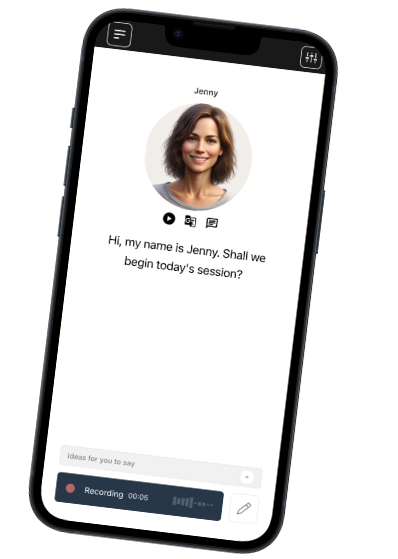
Talkio is the ultimate language training app that uses AI technology to help you improve your oral language skills!
Try Talkio