The Growing Demand for AI-Based Language Training Worldwide
Last updated on
Editorial owner: Taylor Freeman · Editorial policy
Takeaways:
- Discover the global shifts (from remote collaboration to migration) that are increasing demand for AI-based language training around the world.
- Decode why traditional language education models struggle to keep pace with global learning needs and access challenges.
- Investigate how modern AI language platforms help learners practice speaking consistently regardless of location or schedule.
- Assess the real-world factors influencing global adoption of AI-powered education, including connectivity and cultural diversity.
- Recognize how advancing language learning technology is expanding opportunities for learners, educators, and organizations worldwide.
Did you know? At least 1.5 billion people are currently learning English worldwide while millions study additional foreign languages for work, study, and personal development.
If you’ve ever needed to communicate with colleagues or clients in another country… you’ve likely felt this shift firsthand.
The rise of global communication has made language skills far more visible in everyday life – reinforcing major global language training trends affecting (a) businesses, (b) schools, and (c) individuals alike.
This demand is also reflected in the numbers.
Analysts estimate the global online language learning market will grow from $24.56 billion in 2025 to $63.43 billion by 2032 – expanding at an annual rate of over 14%.
Much of this growth is linked to advances in language-learning technology or greater smartphone access or the emergence of AI-powered education tools that personalize lessons and make learning more accessible across regions.
In classrooms, workplaces, and online communities…expectations are shifting, as well.
Understanding vocabulary is no longer enough – learners are expected to communicate clearly in meetings and everyday interactions.
Because traditional methods often struggle to scale across countries and time zones
Those interested in modern AI-based language training continue to grow among learners and organizations seeking flexible and practical speaking practice.
Global Forces Driving the Demand for Language Training
Several global shifts are changing how people communicate and learn languages across foreign borders.
I. Global Workplaces Are Becoming Multilingual
For sure, you may already observe how local work increasingly requires clear communication across cultures and languages every day.
How much more on an international scale that is aiming for multilingual workspaces?
For instance, global teams collaborate, if not communicate, through video meetings and/or shared documents and/or messaging platforms that connect employees across continents.
Due to this shift, companies increasingly invest in AI-based language training, like Adecco Group, to strengthen communication skill within distributed teams worldwide.
These changes also contribute to the growing global trend in language training…encouraging professionals to prioritize practical speaking skills to avoid being left behind.
II. There are People Living, Studying, and Working Abroad
You might also experience language-learning needs when you are
- relocating,
- studying abroad,
- working, or
- traveling in multicultural communities.
Large migration flows and international education programs bring people from different linguistic backgrounds together daily – empowering migrant education.
This environment encourages greater interest in AI language learning worldwide – helping learners practice conversation before entering real situations.
Many learners also rely on AI-powered education tools that offer flexible practice without location restrictions.
III. Digital Life Brings More Languages Into Daily Conversations
You are also exposed to multiple languages daily through social media, online entertainment, and global virtual communities.
Digital platforms connect billions of users, hence, making it safe to assume the inevitable cross-language interaction common even in casual conversations online, thus, leading to language evolution.
As a result, learners increasingly rely on AI language platforms and other language-learning technologies for consistent speaking practice to thrive in their current environment or situations.
These AI tools help transform every exposure into a structured learning opportunity… improving confidence when speaking onother languages.
In summation, these global shifts explain why the demand for language learning continues to expand across industries and sectors.
Why Traditional Language Education Struggles to Reach Global Learners
If you’ve tried to find consistent language training across countries, you may already notice how traditional systems struggle to support worldwide demand.
I. Limited Access to Qualified Language Instructors
Not to generalize the situation but you may struggle in finding qualified language instructors when local schools or training centers lack, if not absent, sufficient qualified teaching staff available.
Some regions, if not most, are significantly facing deficiencies of certified language teachers, according to the Organization for Economic Co-Operation and Development.
This limits the opportunities for consistent conversation practice and guided feedback.
Quick speculation based on this fact?
It leads learners to increasingly explore AI language tools that provide accessible speaking practice anywhere and are personalized to their learning pace.
This shift also reflects broader global language training needs shaping modern education systems and workforce training.
II. Cost, Scheduling, and Geographic Learning Barriers
You might also face practical barriers when courses require travel or fixed schedules and costly private tutoring sessions.
Traditional classes often follow rigid timetables – clearly making it difficult for professionals or students to balance other responsibilities.
These challenges push many learners to research AI language platforms and flexible language learning technology solutions available online.
Such tools allow learners to practice regularly without scheduling conflicts or commuting long distances – unlocking consistent linguistic growth.
III. Uneven Language Training Quality Across Regions
You may also notice that language training quality varies significantly depending on where you live or study.
Some regions offer advanced programs, while others struggle to provide consistent curriculum or feedback or speaking opportunities.
This uneven, if not unfair, access encourages greater adoption of AI language learning worldwide through scalable AI-powered education tools.
One thing it can guarantee is that it aims to provide consistent learning support regardless of location or institutional resources.
Overall, not being able to break the language barriers explain why many learners and organizations are exploring scalable alternatives for language education.
Practical Ways AI Helps Close Global Language Learning Gaps
What limits traditional practices are offset by modern AI-based language training…offering practical solutions that let you continue improving your communication skills from almost anywhere in the world.
Access Speaking Practice From Anywhere
If you struggle to find consistent language practice locally, AI Tools can surely help you train wherever you are.
- Practice conversations without location limits – With modern AI language platforms, you can train from home, work, or while traveling internationally.
- Learn at any time of day – Flexible scheduling allows you to practice when your daily routine actually allows time for study.
- Reduce inter-dependence on local instructors – AI-based language training provides guided conversation even where teachers are difficult to find.
- Maintain consistent speaking routines – Daily interaction helps reinforce vocabulary and build confidence gradually.
- Participate in global learning communities – Many language learning technology tools connect learners practicing similar languages worldwide.
Receive a Consistent Learning Experience Anywhere
For learners moving between countries, institutions, or jobs, consistency in training becomes essential for steady progress.
- Practice with standardized learning structures – Modern AI-powered education tools deliver structured exercises across regions and devices.
- Access the same speaking simulations worldwide – Learners receive comparable conversation scenarios regardless of geographic location.
- Track progress using data-based feedback – Many AI language platforms analyze pronunciation, grammar, and fluency patterns.
- Continue learning while relocating or traveling – Your lessons remain available without needing to change teachers or programs.
- Follow clear improvement paths – Structured practice sessions guide learners step-by-step toward stronger communication skills.
Adapt to Different Linguistic Levels
Language learners often progress at different speeds so adaptable training environments make learning more practical.
- Choose topics you can practice that is suited to your proficiency level – AI-based language training adjusts exercises for beginners through advanced learners.
- Train with multiple accents and speaking styles – Exposure to global pronunciation patterns supports AI language learning worldwide.
- Focus on practical conversations – Many AI language platforms simulate workplace discussions, travel situations, and everyday dialogue.
- Receive targeted pronunciation feedback – Modern language learning technology highlights sounds or phrases that require improvement.
- Expand to additional languages when needed – Many platforms support multiple languages within a single learning environment.
These features help make language learning more accessible and structured – making it practical for learners across different regions and life situations.
Key Considerations When Expanding AI Language Learning
As you explore AI-based language training, understanding global conditions can help you evaluate how effectively these technologies support learners across different regions.
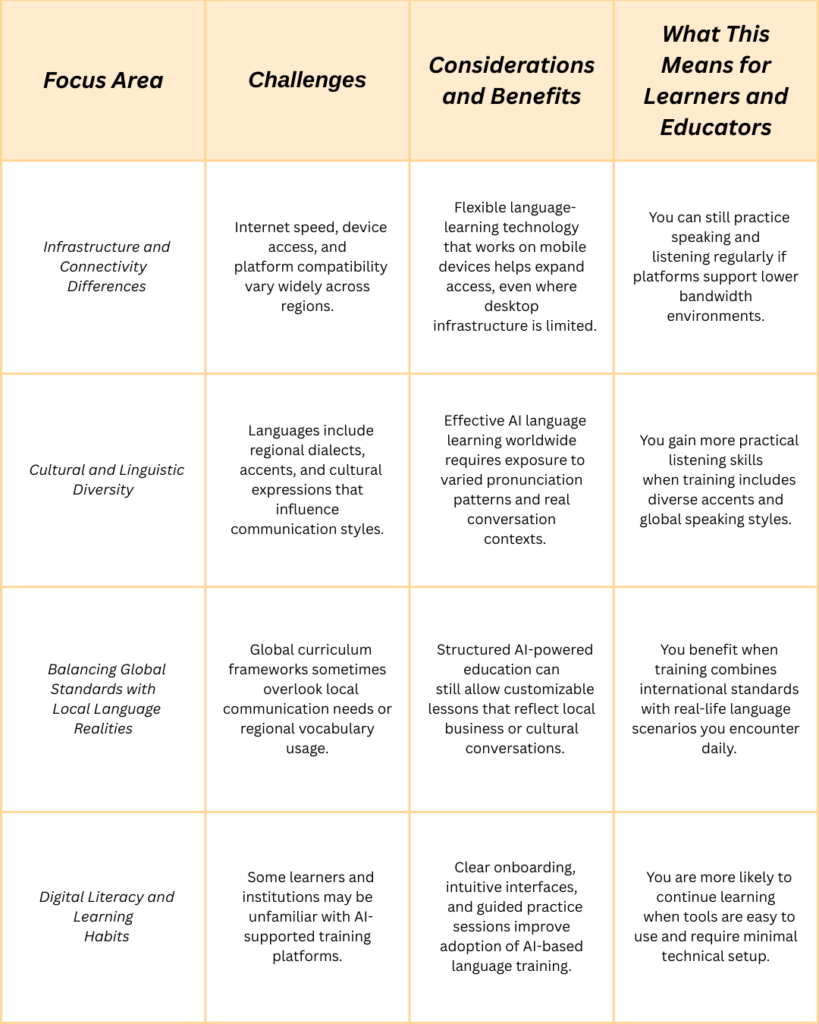
These factors help explain why thoughtful implementation is essential as AI language platforms expand across global education and training systems.
Wrapping Up!
Across workplaces, may it be in classrooms, offices, and online communities, the need for practical communication skills continues to expand worldwide.
As global collaboration increases, language ability is no longer a local advantage but a widely expected professional and social skill.
Traditional learning systems alone cannot meet this scale…which explains the rising interest in AI-based language training and modern language learning technology.
By offering flexible access and/or consistent learning experiences, and/or adaptable practice environments, AI language platforms help learners develop real conversation skills wherever they live.
Solutions such as Talkio AI demonstrate how AI-powered education is helping expand language-learning opportunities across borders.
Curious about our pricing plans?
Feel free to visit our Pricing Plan to explore pricing options and discounts.
You can review pricing tiers and choose the option that fits your language learning goals.
Want to dig deeper into our language learning insights?
Our blogs section features practical guides, industry updates, helpful resources about AI language learning worldwide and modern language training methods.
Talk Your Way
to Fluency

Talkio is the ultimate language training app that uses AI technology to help you improve your oral language skills!
Try Talkio